Introduction
Transporting heavy machinery in the modern industrial world is a process that requires accuracy, power, and security. The use of modern transportation equipment has reduced the chance of injury and the cost of labour required for moving heavy loads. Using the right equipment for every task can make the job more efficient. An error may result in time loss, harm, or even accidents.
This guide discusses the various categories of moving equipment used in heavy machinery. It provides practical information to help you choose the best option for your specific job.
Different Heavy Machinery Moving Equipment

You can select from a variety of moving equipment on the market based on the type of work that needs to be done. Here are the definitions, features, advantages, and disadvantages of each one explained.
1. Air Casters
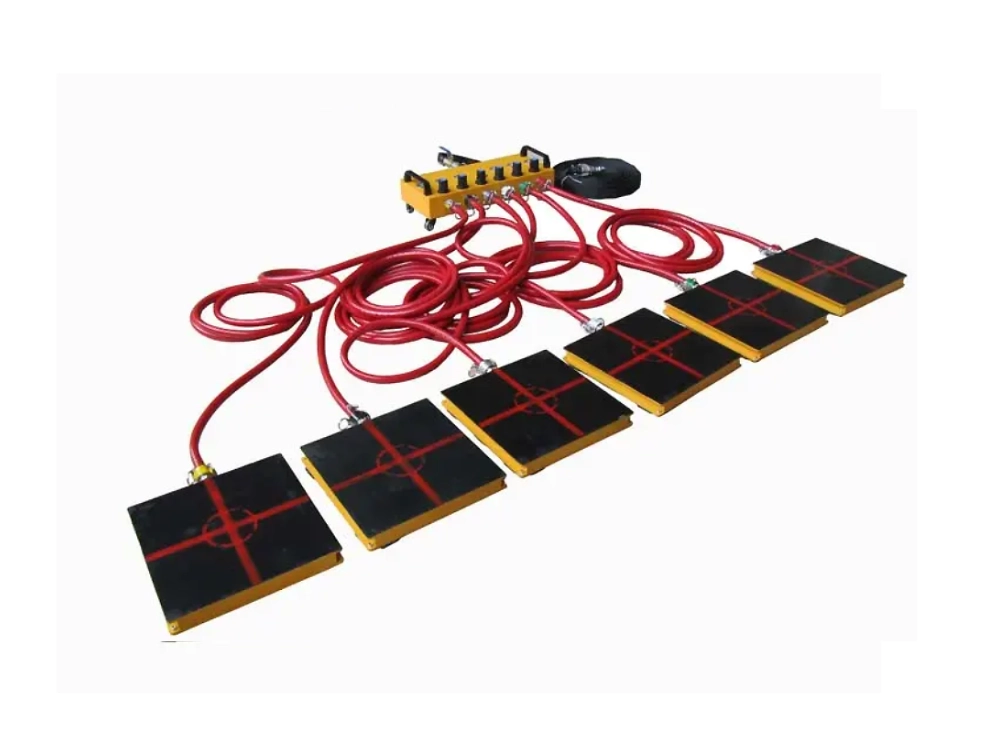
Other names that can be used include air skates, air-bearing casters, and air rigging skates. An air caster can move heavy loads without being affected by friction. It is a frictionless solution for moving heavy loads.
Definition
The air casters use compressed air to create a thin layer of air, ranging from 0.003 to 0.005 inches thick. The air film is formed between the load and the floor. Initially, the heavy load is lifted above the ground, and an air film forms, reducing friction to a minimum.
Features
- It can move loads from 10 to 120 tons.
- It can move in any direction, reduces the chance of floor damage, and is easy to use.
- The air casters are a budget-friendly solution for moving heavy loads.
Pros and Cons
- Air casters from Fine Lifting Tools have accessories that are easy to replace.
- Higher precision control over the console with 4-6 buttons for adjustment.
- The pressure is maintained at 45 MPa for smooth film formation.
On the other hand, the disadvantages are:
- These cannot be used on rough surfaces.
- A constant air supply is required.
2. Air Film Movers
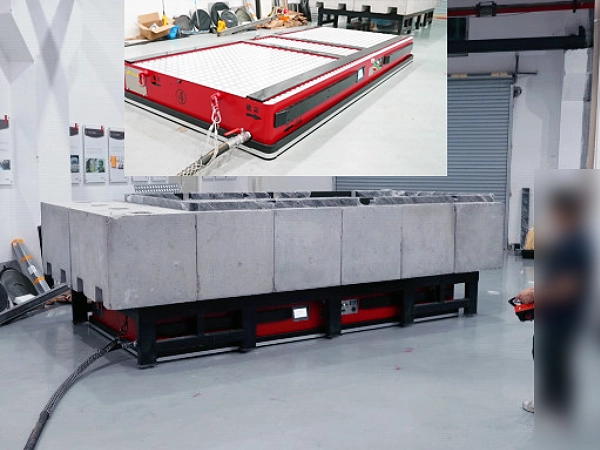
Air film movers are similar to air casters except that they utilize air cushion technology and are more versatile for industrial operations.
Definition
These movers create a cushion, approximately a micron in diameter, between the load and the ground, using compressed air to reduce friction during transportation.
Features
- This equipment can handle loads ranging from 10 tons to 600 tons.
- Available in OEM or ODM
- Easy to install and use.
Pros and cons
- This equipment has high mobility, allowing it to move in any direction.
- Sustainable solution for moving heavy loads.
- The Air Film Mover is designed to handle and precisely position heavy loads with efficiency.
Disadvantages are:
- The air cushion requires a constant supply of air for its operation.
- They work best on smooth surfaces.
3. Battery-powered Machine Skates

Modern, smart machines, such as battery-powered machine skates, are used to remotely control the movement of loads.
Definition
These are very heavy-duty skates, possibly propelled by rechargeable batteries, and can move loads of up to 100 tons.
Features
- Forward, reverse, and directional movement by wireless remote control.
- Lithium-ion batteries (non-combustible and safe).
- Battery-powered machine skates can work both outdoors and indoors.
Advantages
- Precise maneuvering in constricted areas.
- Remote control manoeuvrability.
- Removable and replaceable battery pack.
Disadvantages
- Limited by battery runtime.
- Greater initial expense than manual
4. Forklifts (Heavy Duty)
Definition
Heavy-duty forklifts are multipurpose lifting machines used for transporting heavy loads over short distances.
Features
- They have powerful hydraulic lift arms.
- The load lifting capacity is about 18-33 tons or more.
- Various loading capacities on the model.
- Forklifts can work on rough surfaces.
Advantages
- Adaptable and abundant.
- Appropriate for use indoors and outdoors.
- Deals with different weights and shapes of loads.
Disadvantages
- Lack of accuracy in air-based movers.
- Needs operators and frequent upkeep.
- The internal combustion engine produces pollution.
5. Cranes (Mobile or Overhead)
Definition
Cranes are needed to move and pick up machinery that cannot be moved by rolling or pushing. They employ hooks and cables to lift heavy equipment. The load suspension is done by using cranes.
Features
- Cranes are available in both mobile and fixed overhead configurations.
- The load capacity of an average crane is about 22,000 lbs to over 170,000 lbs.
- It may cover extensive distances.
Advantages
- Ideal for vertical lifting.
- It is capable of transporting loads in places that are not reachable by skates or forklifts.
- Works with heavy machinery.
Disadvantages
- Expensive operational and rental expenses.
- Demands expertise in rigging and safety measures.
Key Factors to Consider When Selecting Equipment
There are specific factors that must be considered while selecting the moving equipment:
1. Load Capacity
Different equipment has different load-bearing capacities. Like an air caster can move 10-120 tons of load, air film movers can move 10-600tons of weight and so on. The load capacity is the key to selecting the best equipment for the job. Suitable load-bearing equipment for the load can reduce the chance of tripping and slipping. That will, in turn, reduce the chance of workplace injury.
2. Surface and Environmental Conditions
Before selecting the right equipment, consider the surface and environmental conditions. Air casters and air film movers can only be used on smooth surfaces. If you need to move a heavy load on a rough surface, consider using a forklift or crane.
3. Space and Maneuverability Requirements
Considering the space for movement of heavy loads is a significant factor in choosing suitable equipment. A battery-powered machine skate is most suitable for constricted areas, while a crane can only be used in an open space. Air film movers have high flexibility and can be used in small areas as well.
4. Power Availability
Air film movers, also known as air casters, require a constant supply of compressed air to move heavy loads. Similarly, battery-powered machines require a constant supply of energy from a lithium battery. Therefore, it is advisable to check your area’s power supply before making any decision.
5. Budget and Cost-Effectiveness
The most important task is to conduct a cost-benefit analysis for the equipment you plan to use. Consider using a budget-friendly solution for moving heavy loads. Cranes and forklifts are expensive options, while air casters and air film movers are more budget-friendly.
6. Safety and Ergonomics
In a workplace where there is a constant movement of heavy loads, the operator’s safety is at risk. Try to use the solutions that are safe and provide ergonomic support. A crane or forklift is hard to handle and requires an operator to upkeep, while air film movers, air casters, and battery-powered machine skates are easy to handle and operate.
Steps to Selecting the Right Equipment
Here is the summary of the steps for selecting the right equipment for the appropriate job.
- You need to check the weight of the load and its size.
- Assess environmental and floor conditions, and determine whether an air caster or air film mover can be used on the surface.
- Establish space and manoeuvre requirements.
- Availability of power supply for the proper working of the moving equipment.
- Compare the costs and benefits of the operation.
- Prioritize safety and compliance requirements.
- Get supplier customization.
Conclusion
The choice of the appropriate heavy machinery moving equipment involves a wise compromise between safety, efficiency, and costs. Air casters and air film movers have ideal applications in controlled environments where smooth and frictionless motion is required. Battery-powered skates will provide wireless accuracy, and forklifts will be able to lift items with greater flexibility. Cranes are the most suitable option for large-scale lifting or vertical lifting.
Evaluating your loading needs, surface conditions, and budget will help you make an informed decision that ensures the job runs smoothly and your valuable equipment remains safe. No, it is not only a matter of convenience when it comes to investing in the right machinery mover, but also a way to protect your assets and enhance productivity.