
Air casters are new load-moving equipment that utilizes compressed air to push heavy machinery. They provide a frictionless, thin layer of air between the object and the floor, enabling giant equipment to move easily.
This type of technology is air-based, meaning it is safe and does not harm the floor, unlike wheels, rollers, or mechanical casters. Some other devices are commonly used in factories, warehouses, and assembly lines.
History and Development of Air Casters
Air film technology dates back to the 1930s, when Finnish engineer Toivo Kaario invented a small craft that rested on a pillar of air. By the 1950s, the first hovercraft was operated using this technology in England.
Air casters were first used in the 1960s to transport heavy machinery in the United States. Air casters today are a proven method for accurate transportation in the manufacturing, energy, and transportation industries worldwide.
Air Casters are Suitable for Moving Heavy Objects/Equipment
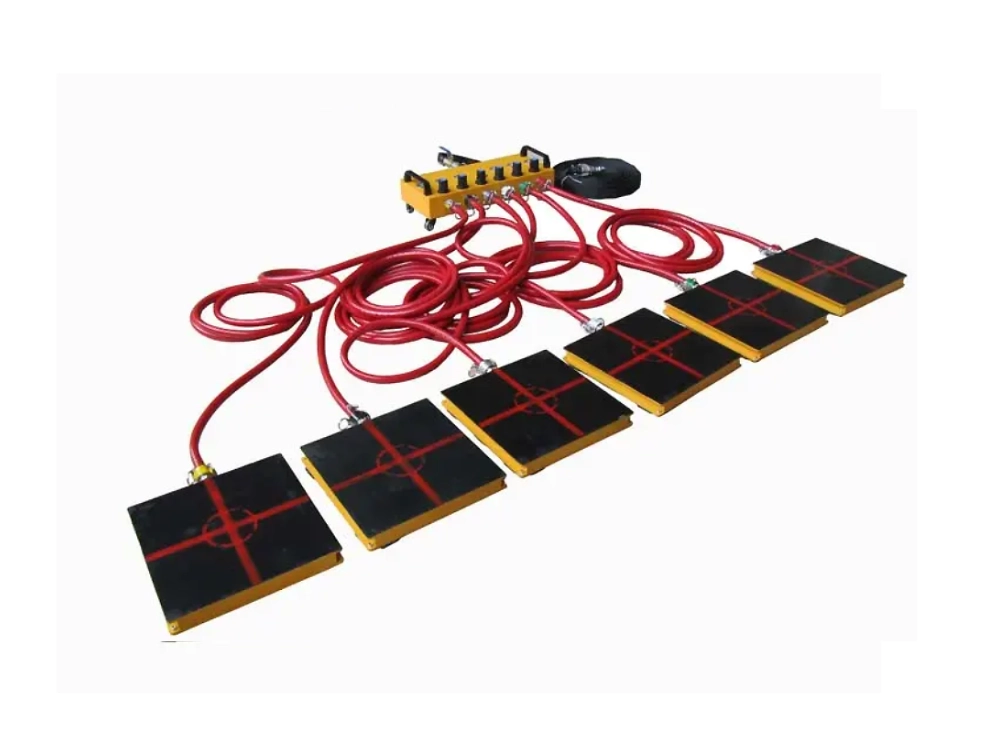
The air caster system is highly efficient in transporting heavy loads. Small systems may be loaded with 500 kg to 100 tons, whereas larger modular systems may be loaded with more than 1,000 tons.
Practically zero friction means that only 1 kg of pushing force is required to move a 1,000 kg load. The load is supported by air, which means no pressure is applied to the floor, thereby avoiding cracks, scratches, and other surface damage. They are also ideal because they can move in any horizontal direction, allowing them to fit into tight areas and place delicate equipment or clean rooms.
Key Components of Air Casters
A complete air caster set-up consists of:
· Air Bearings or Air Pads
These are flexible sheets that are inflated to support the load.
· Air Flow Distribution Valves
Even lifting is achieved by controlling the airflow.
· Compressed Air Source
Shop air of 90 psi (6.2 bar) is usually used as the pressure required to create the air cushion.
· Control Modules and Hoses
Connect a series of casters to work together as a unit. These elements work together to provide an even distribution of weight, creating a stable and floating platform.
How Do Air Casters Work?
The air casters have four straightforward operation steps:
1. Placement and Connection
The casters are fitted under the object and have a supply of compressed air attached.
2. Inflation
Air gets into the membrane, inflating it and a little lifting the load.
3. Air Film Creation
Extra pressure causes air to push under the membrane, forming a thin, frictionless layer between the load and the floor.
4. Floating Motion
A constant air stream holds the object suspended, allowing it to move freely in any direction.
The combination of this technology enables vibration-free transportation, eliminating the need for mechanical action.
What Requirements Do They Need to Meet?
To achieve the best results:
- Air casters require a smooth, level, and stable floor, such as polished concrete, which is often the standard.
- Any cracks and gaps should be sealed to prevent air leakage.
- It must have a consistent supply of compressed air, and the length and size of the hose will be altered according to the distance to ensure pressure.
- Meeting these conditions, floors may be enhanced with overlays or sealed joints.