Moving heavy equipment is a typical job in numerous factories and workshops. Machines, tools, and large items can weigh many tons. They cannot be safely pushed by hand without some form of proper support. Poor moving methods can injure workers, damage floors, and disrupt production.
Two common methods of moving heavy loads are air casters and conventional rollers, or perhaps machine skates. Both assist in moving heavy objects, but they operate in very different ways. Each method has obvious strengths and limits.
The right choice depends on the loading, space, floor, and workflow requirements. This article explains both systems in simple terms. It also compares their performance, safety, cost, and practical applications.
What Are Air Casters?
Definition and Working Principle
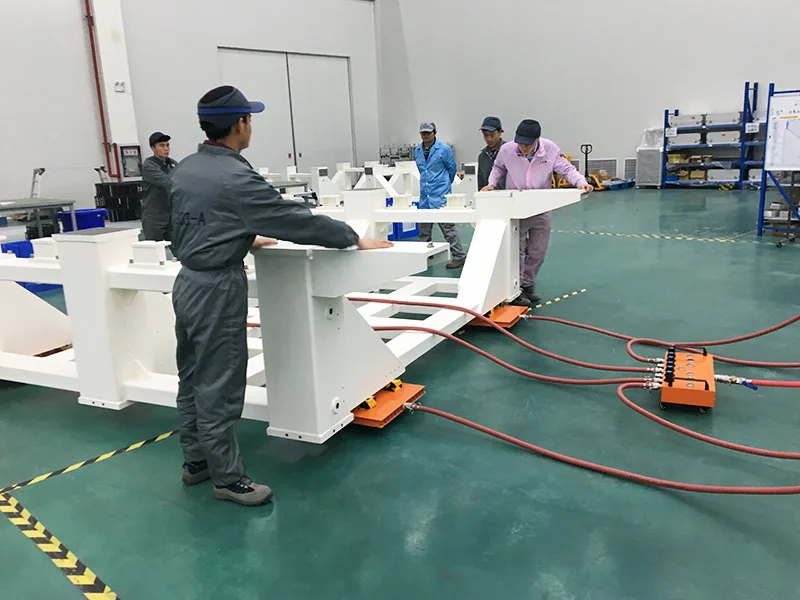
Air casters create levitation of heavy equipment by air pressure and lift it slightly off the floor. They form a thin layer of the air between the load and the surface. This layer of air makes the air friction nearly completely zero. The load then floats and can be moved with very little pushing force.
Most air casters are used between fifteen and sixty psi of air pressure. A heavy machine can be pushed with only a small amount of force. It functions like an air hockey table. When the air ceases, the load is back on the floor.
Types
There are various shapes and load ratings of air casters. Some are round, and some have flat pad designs. They can be used singly or in a set. Light systems are used to move smaller machines or equipment carts.
Multiple units can be used to handle heavy systems that may weigh many tons. Some air casters come made for tight spaces. Others work on lengthy moves around factory floors. There are also custom designs for out-of-the-ordinary machine shapes.
Advantages and Disadvantages
Air casters require little force to move heavy loads. They provide for easy motion in any direction. More accurate positioning is easier when fewer workers are involved. There is very little friction, so they protect floors. They also require less vertical clearance than wheels. Air casters reduce strain and the risk of worker injuries.
However, they require a constant supply of air to work. They are also best for smooth and sealed floors. Rough or uneven surfaces may require a higher air pressure.
What Are Traditional Rollers/Machine Skates?
Traditional rollers have wheels to transport heavy equipment. The load is placed directly on the wheels, and its weight rests on the floor. Workers push or pull the load to get it moving forward. Rollers are often provided in sets, which are placed under machines.
Some systems have swivel wheels for turning. Others use fixed wheels to allow for straight movement. Rollers have been involved in factories for many years now. They are, however, still a common solution because of easy access. However, they require a great deal of careful handling and experience.
Air Casters vs Traditional Rollers
Definition and Working Principle
Air casters are used to float the air loads on compressed air beneath flexible pads. Traditional rollers are used for moving loads by rolling the wheels along the floor. Air casters reduce friction by lifting the load slightly. Rollers reduce friction by spinning wheels from the weight.
Air casters have free movement in all directions. Rollers often restrict movement to straight or guided paths. Turning with rollers usually requires additional effort or repositioning.
Types
Among the air casters are light casters, heavy casters and custom systems. They often work as grouped sets under large machines. The traditional rollers are fixed skates and swivel skates. Some rollers have steel wheels for high loads. Some use softer wheels for lighter pieces of equipment. Rollers will also feature steering handles or tow bars. Each type is appropriate for certain loads and floors.
Advantages and Disadvantages
Air casters take very little physical force to relocate loads. One man can shift tons with a proper setup. They provide smooth, controlled and accurate positioning. They cause less damage to the floor due to the low surface pressure. Air casters also reduce the risk of injury during movement. However, they need clean and smooth floors. They are also dependent on a reliable source of air.
Traditional rollers are widely available and easy to understand. They do not need air or power. Rollers are used on more types of floors than Air casters. However, they require more effort to push heavy loads. With wheeled systems, it is more difficult to precisely position everything. Rollers can be destructive to the floors under extreme weight. They also create more safety hazards in case the loads shift suddenly.
Conclusion
Both air casters and traditional rollers have uses in factories. Each of them plays a role in safely moving heavy equipment when used properly.
Air casters are ideal for jobs requiring precision, low effort, and tackling floors. They perform well in congested areas and smooth locales.
Traditional rollers are best for simpler tasks with fewer setup requirements. They are still useful where an air supply cannot be obtained.
Choosing the method to use depends on the load and the condition of the floor. Space limitations and frequency of movement also have an impact. Understanding these factors helps eliminate risks and save effort.
A brief overview of the advantages of Finer Brand Air Casters can be found by clicking here. Please contact us for more information.