
Heavy equipment is moved from one location to another using battery-powered machine skates. They are used in factories and warehouses to transport loads without the need for forklifts or manual pushing. Some models can be used to transport loads from 10 to 100 tons.
These skates have many parts to operate safely on factory floors. Each part has a distinct function to perform. This article discusses these components in detail.
Steel Frame
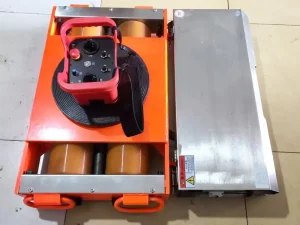
The steel frame bears the entire weight of the load. It should be tough and withstand heavy machinery and industrial tools.
High-strength steel plates with a strength of 1100 to 1300 MPa are widely used in battery-powered machine skates. To prevent bending and damage during transport, some frames feature 12-mm-thick steel plates.
It also comprises the motor, wheels, battery box, and turntable. Some skates feature a three-point design, with one motorized front skate and two rear skates. This allows even weight distribution.
Electric Motors
The motor is the driving force. Dual-drive motors are the most common type of battery-powered machine skates. Two motors provide enhanced force and smoother steering.
The motor size varies from model to model. The motors are available in a power range of 400-2500 watts. The 35-ton and 50-ton models use 1500W or 2000W dual motors. These strong motors give the skate long-lasting durability.
The larger the motor, the more equipment it can move. Some machine skates can reach speeds of up to 8 meters per minute when fully loaded.
Gearbox System
The gearbox transmits power generated by the motor to the wheels. The motor would spin too quickly without a gearbox and become ineffective at pulling.
Usually, 6JU100L or 7JU100L gearboxes are used for battery-powered machine skates. These gearboxes are used to enable the skate to move at low speed and under heavy load.
The gearbox also assists the skate in ascending small slopes. Many models can handle slopes of 15 degrees or more.
Lithium Battery
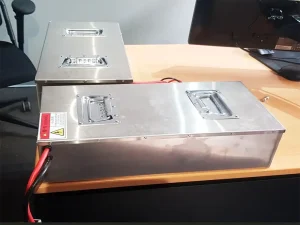
The battery supplies electricity to the motors and control system. Most skates use rechargeable ternary lithium batteries or lithium-ion batteries.
Battery size changes with load capacity:
- 30Ah battery for 10T skates
- 60Ah battery for 20T to 30T skates
- 120Ah battery for 35T to 80T skates
Many systems use 48V batteries. Some skates last more than 6 hours on a full charge. Others run for 8 hours under light loads or 3 to 6 hours under maximum loads.
Most batteries are removable. Operators remove the battery for charging or replacement. Many systems also include battery display screens to show remaining power.
Wheels and Rollers
The wheels carry the load and help the skate move smoothly across the floor.
Many machine skates use imported polyurethane wheels. Polyurethane gives good toughness and elasticity. These wheels resist wear better than ordinary rubber wheels.
Wheel size changes with skate capacity. Small models use wheels around 130 mm wide, while larger skates use wheels up to 160 mm wide.
Smooth floors help wheels last longer. Rough roads, potholes, gravel, or sharp surfaces damage the wheel surface. Heavy turning in place also damages wheels and bearings.
Operators often turn slowly while moving forward instead of turning in one spot. This reduces stress on the wheels.
Remote Control System
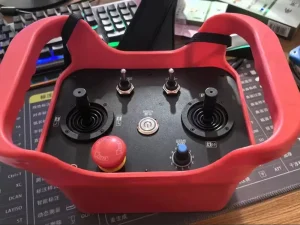
Remote control systems allow an operator to move heavy tools without manual pushing or pulling.
Most systems use wireless remote controls with buttons or push rods for:
- Forward movement
- Reverse movement
- Left turns
- Right turns
- Speed adjustment
- Stop control
Some remotes include cruise control functions. Industrial remote controls are often waterproof.
Turntable and Steering System
The turntable is positioned on top of the skate, carrying the load as it is moved. The diameter of most skate turntables is 250 to 320 mm.
The turntable turns when steering. This assists the skate to turn corners and maneuver through factory areas.
It is more difficult to turn if the load is heavy. The operators need to drive gently under heavy loads to avoid damaging the wheel and bearings.
For greater steering control, some systems feature 360-degree swivel saddles.
Safety Protection Systems
Battery-powered machine skates come with safety features to minimize damage and accidents.
Some common protections include:
- Overweight protection
- Overspeed protection
- Overheating protection
Operators are still required to adhere to safety rules. When handling heavy loads, roll slowly, particularly when turning.
Manufacturers also recommend using between 50% and 70% of the rated capacity on rough floors. This takes tension off the wheels and frame and lengthens the service life.
Conclusion
Battery-powered machine skates require some key components to function. Load is carried by the steel frame, movement is provided by the motors, energy is provided by the batteries, and the weight is supported by the wheels. Operators can safely and accurately position heavy machinery using remote controls and steering systems.
These skates are used to support the transportation of heavy machines in factories with reduced manpower and improved control.