
Introduction
Air casters are devices used to transport machinery in heavy-duty applications via a thin film of compressed air. The main function of an air caster is to reduce the friction by creating an air cushion between the load and the floor. This helps the air caster move heavy loads with minimal effort.
Air caster systems are widely used in manufacturing plants. Aerospace facilities and power generation also rely on air caster systems. They are also in high demand for industrial material-handling projects because they can easily handle sensitive and oversized loads.
Knowledge of the key components of an air caster system is important for understanding how the system works. Each part has its own function or plays a unique role. Whether the concern is generating lift or ensuring smooth movement.
The following discussion will help you to understand the basic functions of the components of an air caster system.
Key Components of an Air Caster System
Air Bearing
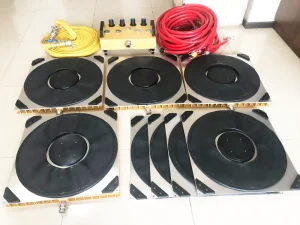
The main component of an air caster system is the air bearing.
- This component’s main function is to create a thin layer of air that lifts the load just above the floor surface.
- Compressed air is pushed under a flexible diaphragm when it enters the bearing.
- The air is then released uniformly around the bearing’s circumference, forming an air cushion.
- The main purpose of this component is to lift heavy loads by supporting smooth movement. This component is used to distribute the weight evenly. So the quality of bearings contributes to improving the load distribution and stability during operation.
Flexible Diaphragm
- This component of the air caster system is connected to the air bearing assembly. The absence of this diaphragm component highly affects the air caster operating system.
- When compressed air is supplied to the system, the flexible diaphragm expands. This expansion forms an enclosed space or sealed chamber. With the help of this sealed chamber, an air cushion is built that is required for lifting.
- Commonly, durable materials (capable of heavy industrial use) are used to manufacture this component.
- The main function of this component is to maintain the air pressure. It enhances the efficiency of the air caster system.
Compressed Air Supply

- There is a need for a continuous supply of air to operate the air caster system.
- The compressed air system provides the necessary air flow to inflate the air bearings. It keeps the air film between the load and the air bearings.
- The safe and efficient operation relies on stable air pressure. There should be enough air pressure and flow to lift the load being transported.
- Most commonly, industrial air compressors are used as a source of compressed air. Central compressed-air systems or dedicated compressed-air units are also used for this purpose.
Air Hose and Distribution Network
- A compressed air supply needs to be provided from the air source to each air bearing. Air hose and distribution system do this job.
- The main function of a distribution network is to ensure an even flow of air pressure to each air bearing.
- The risk of pressure loss throughout the system can be reduced by correct hose sizing.
- Lifting performance and load stability may also be impacted by uneven airflow.
Drive Unit
- External force is used to move the loads in some air caster systems. The drive unit is used to move heavy objects with high accuracy.
- Electric drive systems and pneumatic drive units are common drive options.
- When moving heavy loads over long distances, powered drive units are an ideal choice.
Control Valve System

- The main function of the control valve is to control the flow of air in the air caster system.
- The operator uses the valve to adjust the air pressure fed to the bearings. This can be used to improve lifting performance in accordance with the load’s needs.
- Manual control valves and pressure regulators are also used for this purpose. The control system also includes flow control devices and safety shutoff valves.
Load Support Frame
- To attach the air casters to equipment that must be moved, a load support frame is used.
- The main function of this component is to distribute weight over several air bearings.
- One of the primary functions of this component is to maintain balance and protect the air-bearing system.
Steering and Guidance System
- While air casters reduce friction, a directional control system is still required. Steering and guidance are components that assist operators in load control.
- Positioning accuracy is enhanced with effective steering. It plays an important role in moving equipment in confined production areas.
Pressure Monitoring Devices
- To ensure safe operations, pressure monitoring devices perform their role. These components are used to continuously measure air pressure in the system. These devices are used for stable lifting performance.
- Pressure gauges and digital displays are commonly used for monitoring. Monitoring sensors and alarm systems are also used to maintain the correct air pressure.
Floor Surface Interface
- The floor surface significantly affects the performance of air casters. Air casters work best on smooth, sealed, and level floors. For example, it works well on smooth industrial flooring.
- If the floor conditions are poor, lifting efficiency will decrease. Also, the air consumption will increase. Therefore, the suitability of the floor should always be considered before installing an air caster system.
Conclusion
The discussion above explains how a caste system works. Every component of this system is designed to perform a unique job in lifting the heavy loads. By understanding the functions of these components, manufacturers can choose the right air caster configuration for their applications.
Looking for air caster solutions for your facility? We can recommend appropriate system configurations based on load weight, floor conditions, and operational needs. You can contact our team to discuss your project, get help, and determine the solution for your application.