
Introduction
For less frequent heavy load movements, air bearing modules, also known as air casters and air skates, are in use. The load-bearing capacity of the air bearing ranges from 10 to 120 tons, and they are easy to use. A few Newtons of force are needed to move the heavy loads from one place to another.
In this article, you will learn about the air bearing modules, how they work, and the pros and cons of using air movers for heavy load moving.
Definition of Air Bearing Modules
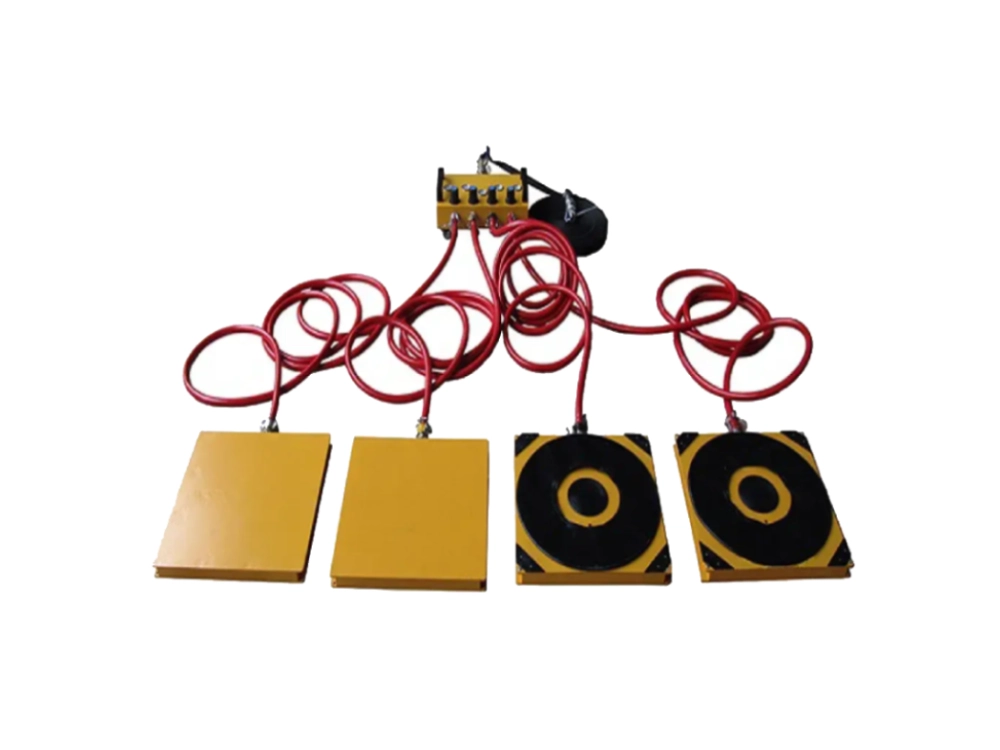
Air bearing modules, air skates, or air casters utilize a very thin layer of pressurized air to help suspend a heavy load above the ground. The micron-level air film formation between the floor and the heavy load reduces the friction to nearly zero. Minimum effort is required to move the heavy loads in tons.
The air bearing modules operate on a smooth, crack-free, and obstruction-free floor. They are typically arranged in 4–6 sets, and adding more modules increases their load-bearing capacity.
How Air Bearing Systems Work
The use of compressed air for moving heavy loads is the basic working principle of air bearing systems.
- The system consists of sleeves between the shafts, separated by 5-50 microns.
- The air-bearing orifice feeds air at 2–25 bar into the sleeves.
- The air bearing modules fill the air cushions or form the air film between the load and the bearing surface.
- This air cushion or air film acts as a lubricant, allowing the heavy load to flow effortlessly.
- The pressure on one side of the shaft increases, while the pressure on the other side decreases, helping propel the air movers.
- An air skate or the air bearing has a constant supply of compressed air.
- The coefficient of friction is reduced almost to zero, which results in a minimum force required for movement.
- The modules are placed at an equal distance for equal weight distribution.
Advantages and Limitations
There are numerous advantages to using air bearing modules; however, there are some disadvantages associated with their use. The benefits and drawbacks of using air-bearing modules are detailed here.
Advantages
- You can use air-bearing modules in confined areas; they rotate 360 degrees. They help ensure accurate movement of heavy loads.
- The use of air film movers and air film for moving heavy loads has reduced the chance of wear.
- There is a reduced risk of workplace injury with air-bearing modules.
- The smooth movement results in low vibration and no noise.
- There is no need for lubrication as the air film acts as a lubricant.
- The benefits include enhanced maneuverability and low maintenance, which improve the operational benefits.
Disadvantages
- The initial cost of the air bearing module is high.
- You can only use air casters or air bearings on smooth floors; the floor must be smooth.
- A constant supply of compressed air is required.
- If the air supply is damaged, it can lead to contamination and serious issues.
Conclusion
Many industries are using an efficient, accurate, and low-friction means of effortlessly transporting heavy loads with minimal effort. Since they use a thin film of compressed air, mechanical contact is eliminated, minimizing wear, reducing vibration, and reducing noise during transport.
Their 360-degree rotation capabilities make them useful in tight spaces and for handling sensitive equipment. Such modules, however, do need crack-free, smooth flooring and an uninterrupted air supply.
The air bearing modules promise high reliability, especially in industries with heavy machinery, delicate elements, or large assemblies. This reliability across modules stems from the long-term operational benefits they offer, which make them worthwhile despite the steep price. Contact us at Finer Lifting Tools for the best heavy-load moving solutions using air-bearing modules.