
Introduction
Moving and positioning heavy loads has become very simple in modern industrial operations. Every step in modern industry requires modern equipment. These pieces of equipment make the very risky and tiring job of moving tons of materials very efficient. Minimal force and labour are required to move tons of material in industrial settings.
The use of material handling equipment has transformed the world of heavy-load movement. Using these machines can improve:
- Safety
- Productivity
- Reduces cost
- Smooth workflow
The need for specialized material-handling equipment has transformed modern industry. This equipment includes manual tools, automated machines, and air-powered machines.
In this article, you can understand what material handling is, its types, and its advantages. Let’s examine all of this material in more detail.
What is Material Handling?

The literal meaning of material handling is the management of the movement of heavy loads. The movement of material from manufacturing to the consumption stage requires material handling. The transfer of raw materials to the production phase. The merchandise is then sent to the warehouses for storage. Material handling is also responsible for distributing materials for consumption.
Different kinds of material handling could be used in the industries:
- Manual material handling
- Semi-automated
- Fully automated
The choice of option depends on the task’s complexity and precision requirements. For example, the lifting and pushing of materials involve manual handling. Automated systems rely on the conveyors and software-driven equipment to perform tasks. All fully automated material handling is based on ergonomic principles.
A fully equipped material handling guarantees the following:
- Right material placement
- Right placement at the right time
- The condition remains intact
- Reduce the labour force
- Reduces the cost of movement
- Reduces the hazards
Types of Material Handling Equipment
The categories of the material handling equipment are based on their function. The most common kinds of material handling equipment are as follows:
Transport Equipment
Materials are moved both inside and outside the work area via transport equipment. The material, load, and environment all influence the equipment selection. This transport equipment can help in:
- Reducing manual handling
- Minimizing travel time
- Improving overall throughput
The powered and non-powered solutions of transport equipment include:
- In the use of the conveyor within an industry for continuous movement.
- Automated guided vehicles (AGVs)
- The use of cranes for vertical lifting
- Autonomous mobile robots (AMRs)
- Air-powered transport systems for heavy or oversized loads
Unit Load Formation Equipment
Sometimes in the industry, it is more convenient to move a batch of materials than an individual item. Manufacturers use unit-load forming equipment for this purpose. Moving a lot of materials in a single trip as a group makes the task more efficient. This method reduces the number of trips required to move tons of materials.
- Pallets and skids
- Containers and bins
- Strapping, wrapping, and banding equipment
This method of moving material has many advantages, such as:
- Reduce product damage
- Smoother transportation
- Standardize handling processes
Unit load formation is especially important in high-volume warehouses and distribution centers.
Industrial Trucks
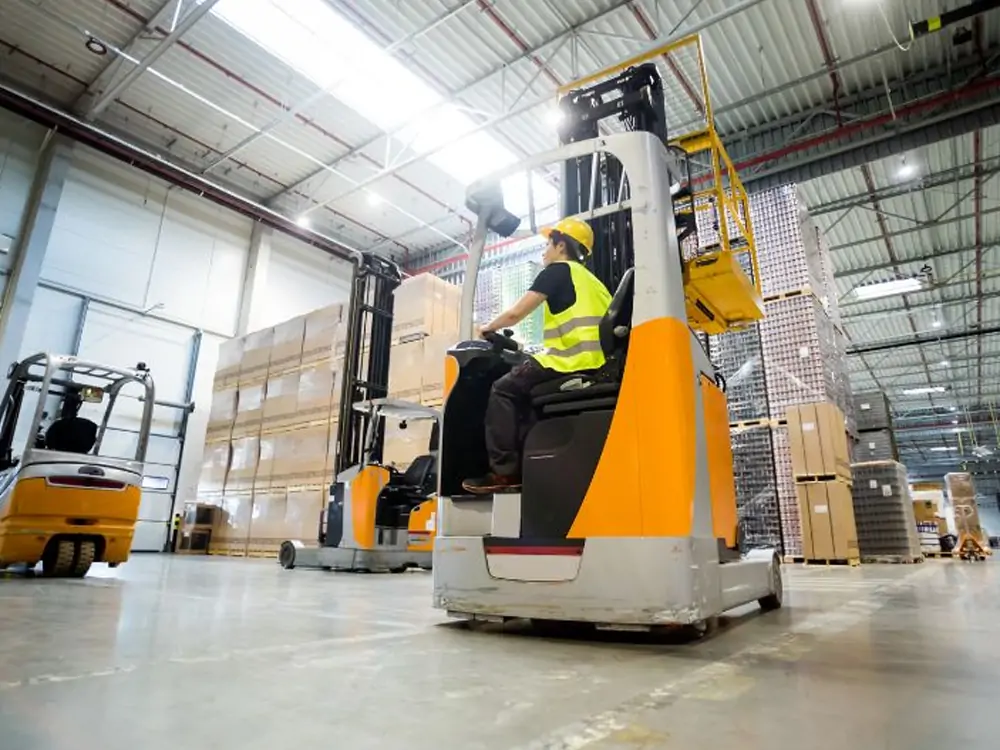
To move, place, and position materials, industries use industrial trucks. These are the most important material-handling tools. Industrial trucks could move the materials over shorter distances.
Common types of industrial trucks include:
- Forklifts for lifting and stacking loads
- Pallet trucks (pallet jacks) for moving palletized goods
- Hand trucks and dollies for lighter loads
- Order pickers for accessing high storage locations
- Side-loaders for narrow aisle operations
Different kinds of industrial trucks can be handled and operated manually. Some of these have electrical power and use an engine. Manufacturers use this equipment across different industries, warehouses, and shipping areas.
Storage & Positioning Equipment
The use of machinery and equipment for storage and positioning is also essential in the industry. These industries could use this equipment to store and position them, making them accessible. A disorderly warehouse is less productive than a well-organized one. Items are kept safe, organized, and accessible as needed using this equipment.
Examples include:
- Pallet racking systems
- Shelving units, bins, and drawers
- Mezzanines to increase vertical storage capacity
- Positioning tables and lift platforms
This material handling equipment maximizes a facility’s use of available space. Making the required material more accessible reduces unnecessary handling. If the material is placed properly, handling becomes more ergonomic.
Advantages of Material Handling
Proper material management in an industry or warehouse yields many advantages. The use of the different material handling equipment has the following advantages:
- In the workplace, the primary concern in material handling is worker safety. Automated lifting and material movement reduce manual handling. This will reduce the risk of slips, trips, accidents, and strains related to handling.
The use of the material handling helps in the:
- Faster material movement
- Reduce travel time
- Streamline workflow
All these features make material handling more efficient and easier. The heavy load can be moved faster with less force.
- Material handling requires minimal labor and is cost-efficient. Modern material-handling techniques enhance space utilization and reduce product damage.
- The use of fully automated material-handling equipment will improve inventory control. The use of material handling will help in tracking material storage and movement.
- Reducing workplace accidents will help build workers’ confidence in safety.
Finer Company’s Material Handling Equipment
A variety of material-handling equipment is manufactured and supplied by Finer Tools. The use of modern material movement equipment has transformed the world of moving heavy loads. The business offers affordable ways to move big loads.
Air Casters/Air Bearings
Manufacturers use air casters to move heavy loads. These are also known as air skates or air caster rigging systems. These machines could move extremely heavy loads using minimum force. The air nodules between the floor and the heavy load create a micron-sized film. Lifting the load above the ground reduces friction during movement.
These air casters can carry loads of 10-120 tons. The user can use the air caster for up to 8 years. The air casters are easy to maintain and operate precisely. You can get a customized air caster based on your load requirements.
Air Film Movers
Another advanced innovation in heavy-load transportation is the air-film mover. A compressed-air cushion is created between the load and the floor. The movement of the tons of materials is carried out very smoothly. Finer Tools uses air-cushion technology in its air film movers. The capacity of the air film movers ranges from 10 to 600 tons.
Sometimes, in the movement of the heavy loads, the floor gets damaged. The use of the air film movers reduces the floor wear and increases efficiency. This equipment offers great maneuverability and can be used in confined areas. All Finer tools and equipment are designed with ergonomic principles in mind. This will reduce workplace injuries and improve task efficiency.
Battery-powered Machine Skates
Another efficient heavy-load-moving equipment is the battery-powered machine skates. These machine skates could be used outside. They support remote control and use a lithium-ion battery to perform tasks efficiently. They have a 100-ton load capacity.
A battery-powered machine skate can provide flexible steering and OEM/ODM options. With this equipment, industries can achieve reliable performance and higher productivity. All of the equipment has applications across industries. These include manufacturing for the aerospace industry, for moving large loads.